At a Glance
- Post Name
- Nursing Officer and Sister Tutor
- Conducting Body
- Madhya Pradesh Employee Selection Board (MPESB)
- Eligibility
- B.Sc Nursing
- Location
- Madhya Pradesh
Quick Summary
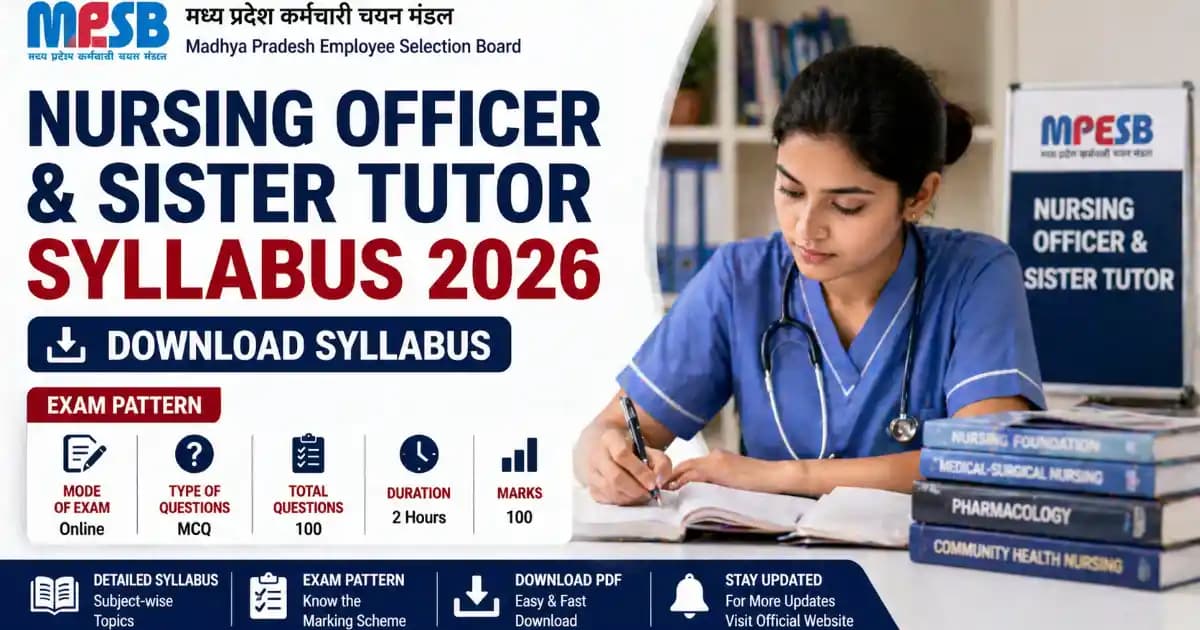
Madhya Pradesh Employee Selection Board (MPESB) has released the syllabus for the Nursing Officer & Sister Tutor Recruitment Exam 2026. Download the complete B.Sc Nursing curriculum and exam pattern.
Madhya Pradesh Employee Selection Board (MPESB) is the state agency responsible for conducting recruitment examinations for various Group B and Group C posts in the state departments of Madhya Pradesh. Its official recruitment portal is esb.mp.gov.in.
MPESB Nursing Officer & Sister Tutor 2026 – Overview
MPESB Nursing Officer & Sister Tutor Recruitment 2026 syllabus and exam pattern have been published by the Madhya Pradesh Employee Selection Board (MPESB). Applications for the recruitment are open at esb.mp.gov.in. The written examination will consist of a single paper of 100 marks, with 25 marks dedicated to general subjects and 75 marks based on the core B.Sc. Nursing curriculum.
| Particulars | Details |
|---|---|
| Conducting Body | Madhya Pradesh Employee Selection Board (MPESB) |
| Examination Name | Nursing Officer & Sister Tutor Joint Recruitment Test 2026 |
| Post Name | Nursing Officer and Sister Tutor |
| Selection Process | Written Examination |
| Total Marks | 100 Marks |
| Official Portal | esb.mp.gov.in |
Source: Official MPESB Nursing Officer & Sister Tutor 2026 Notification, MPESB. Download PDF
MPESB Nursing Officer & Sister Tutor 2026 – Exam Pattern
The written examination will be an objective-type test consisting of a single paper. The paper is divided into two sections, heavily emphasizing the candidate's professional nursing knowledge.
| Section | Subject | Marks |
|---|---|---|
| Part A | General Knowledge, General Hindi, General English, General Mathematics, General Science, General Aptitude | 25 Marks |
| Part B | Subject-specific knowledge (B.Sc. Nursing Curriculum) | 75 Marks |
| Total | 100 Marks |
MPESB Nursing Officer & Sister Tutor 2026 – Detailed Syllabus (Part B)
The 75-mark section is based entirely on the comprehensive B.Sc. Nursing Curriculum. Below is the detailed breakdown of topics semester-wise.
First Year Syllabus
| Semester | Course | Content Topics |
|---|---|---|
| I | Communicative English | Communication, Introduction to LSRGW (Listening, Speaking, Reading, Grammar, Writing), Attentive Listening, Speaking-Effective Conversation, Reading, Writing Skills. |
| I | Applied Anatomy & Applied Physiology | Anatomy: Introduction to anatomical terms, Respiratory, Digestive, Circulatory, Lymphatic, Endocrine, Sensory, Musculoskeletal, Renal, Reproductive, and Nervous systems. Physiology: Basic general physiology concepts applied to the systems listed above, including Blood. |
| II | Applied Sociology & Applied Psychology | Sociology: Introduction, Social structure, Culture, Family and Marriage, Social stratification, Social organization and disorganization, Clinical sociology. Psychology: Introduction, Biological basis of behavior, Mental health and hygiene, Developmental psychology, Personality, Cognitive process, Motivation and emotional processes, Psychological assessment, Application of soft skills, Self-empowerment. |
| II | Applied Biochemistry and Applied Nutrition & Dietetics | Biochemistry: Carbohydrates, Lipids, Proteins, Clinical Enzymology, Acid-base maintenance, Heme catabolism, Organ function tests, Immunochemistry. Nutrition: Carbohydrates, Energy, Proteins, Fats, Vitamins, Minerals, Balanced diet, Nutritional deficiency disorders, Therapeutic diets, Cookery rules, Nutrition assessment, National Nutritional Programmes. |
Second Year Syllabus
| Semester | Course | Content Topics |
|---|---|---|
| III | Nursing Foundation I & II | Foundation 1: Health and Illness, Health Care Delivery Systems, History of Nursing, Communication, Documentation, Vital Signs, Health Assessment, Equipment, Infection Control, Comfort/Pain Management, Patient Safety, Admission/Discharge, Mobility, Patient Education. Foundation 2: Nursing Concepts/Skills/Procedures, Basic Care, Health Promotion, Emergency Care, Medical-Surgical Basics, Pharmacology, Mental Health Nursing basics. |
| III | Health/Nursing Informatics & Technology | Computer Applications for Patient Care, Principles of Health Informatics, Information Systems, Electronic Health Records, Patient Safety & Risk, Clinical Decision Making, eHealth, Healthcare Management Information, Information Law & Governance, Evidence-Based Practice. |
| III | Applied Microbiology and Infection Control including Safety | General Characteristics of Microbes, Pathogenic Organisms, Immunity, Hospital Acquired Infections (HAI), Isolation Precautions (PPE), Hand Hygiene, Disinfection and Sterilization, Specimen Collection, Biomedical Waste Management, Antibiotic Stewardship, Patient Safety Indicators/Protocols, Healthcare Worker Immunization. |
| IV | Community Health Nursing I (inc. Environmental Sci & Epidemiology) | Approaches/Roles in Community Health, Assisting Families, Introduction to Epidemiology, Communicable/Non-Communicable Diseases and National Health Programs, Common Emergencies/First Aid, RMNCH+A, School Health, Demography/Population Control, Environmental Health & Sanitation, Communication Management. |
| IV | Educational Technology/ Nursing Education | Theoretical Foundations, Assessment/Planning/Implementation in Clinical Teaching, Educational Media, Evaluation Methods, Guidance/Counseling, Evidence-Based Teaching (EBT), Emerging Trends in Nursing Education. |
| IV | Child Health Nursing (I & II) | Child Health I: Modern Child-Care, Healthy Child, Neonate Care, IMNCI, Common Childhood Diseases, Child Health Emergencies and CPR. Child Health II: Orthopedic/Sensory/Skin Disorders, Communicable Diseases, Behavioral/Social Problems, Challenged Children, Parent Education, Care in Pediatric Wards, NICU & PICU. |
| IV | Introduction to Forensic Nursing | Basic concepts and introduction to forensic nursing practices. |
Third Year Syllabus
| Semester | Course | Content Topics |
|---|---|---|
| V | Adult Health Nursing II (with Pathophysiology, Geriatric & Palliative) | Nursing Management of ENT, Eye, Kidney/Urinary, Male Reproductive Disorders, Burns/Cosmetic Surgeries, Neurological, Immunological, Oncological conditions, Emergency and Disaster Situations, Geriatric Care, Critical Care Units, Occupational Health Disorders. |
| V | Professionalism, Professional Values and Ethics | Bioethics, Human Values, Ethical issues in clinical practice. |
| VI | Adult Health Nursing I (with Pathophysiology inc. BCLS) | Intraoperative Care, Management of Respiratory, Gastrointestinal, Cardiovascular, Hematological, Endocrine, Integumentary, Musculoskeletal Disorders, and Communicable Diseases. |
| VI | Pharmacology & Pathology (inc. Genetics) | Pharmacology I: Antiseptics, GI, Respiratory, Cardiovascular, Endocrine, Dermatological, Antimicrobials. Pharmacology II: ENT/Eye, Urinary, Nervous System, Hormonal/Contraception/MTP, Pregnant Women, Deaddiction, Emergency, Poisoning, Vitamins/Minerals. |
Fourth Year Syllabus
| Semester | Course | Content Topics |
|---|---|---|
| VII | Mental Health Nursing (I & II) | Mental Health I: Principles, Assessment, Therapeutic Communication, Treatment Modalities, Schizophrenia, Mood Disorders, Neurotic/Stress Disorders, Substance Use, Personality/Eating Disorders, Childhood/Adolescent Disorders. Mental Health II: Organic Brain Disorders, Psychiatric Emergencies, Legal Issues, Community Mental Health. |
| VII | Nursing Management & Leadership | Nursing Services in India, Management Basics (Planning, Organizing, Staffing, Directing, Controlling), Leadership, Organizational Behavior, Financial Management, Nursing Educational Institutions Management, Legal/Ethical Issues, Professional Advancement. |
| VII | Community Health Nursing II | Occupational Health, Geriatric Health Care, Mental Health Disorders in Community, HMIS, Delivery of Services, Leadership/Supervision, Disaster Management, Biomedical Waste Management, Health Agencies. |
| VIII | Nursing Research & Statistics | Definition/Needs, Scientific Method, Characteristics of Good Research, Evidence-Based Practice (EBP) Process and Barriers, Steps of Research Process. |
| VIII | Midwifery/Obstetrics and Gynaecology (OBG) Nursing | OBG I: History, Current scenario in India, National health programs (RMNCH), Respectful maternity care (RMNC), Midwife-led care, Birthing centers, Universal rights, Legal provisions (PNDT, MTP, surrogacy), Midwife roles. OBG II: Management of Pregnancy problems, Deviations in Labour, Postnatal Problems, High-Risk Newborns, Gynecological Disorders, Family Planning. |
| VIII | Competency Assessment | Practical assessments across Community Health, Adult Health, Child Health, Mental Health, and Midwifery/OBG Nursing. |
| VIII | Ex. Scientific Writing Skills & Menopausal Health | Special topics covering scientific writing and specialized health issues. |
MPESB Nursing Officer & Sister Tutor 2026 – Official Links & Syllabus PDF
| Important Links | Click Here |
|---|---|
| Check Full Recruitment Details | Click Here |
| Download Official Notification / Syllabus PDF | Click Here |
| Official Website | esb.mp.gov.in |